Most travelers see the Hazara region as nothing more than a scenic pitstop. They roll through the green, winding valleys of Haripur, Abbottabad, and Mansehra on their way to the high-altitude glacial lakes of Naran or the dramatic turns of the Karakoram Highway. But if you take a moment to look past the modern highway motels and pine-covered hills, you realize that Hazara is a massive, living historical archive.
For thousands of years, this specific corridor served as the primary physical bridge connecting the ancient plains of India with Kashmir, Tibet, and the Silk Road networks of Central Asia. Consequently, almost every major empire that marched through South Asia left its thumbprint here. From Mauryan kings carving moral philosophies into granite boulders to Buddhist monks raising stupas along the Haro River, and from fierce Sikh generals building mud-and-stone outposts to British officers drawing up alpine cantonments—Hazara has seen it all.
If you are a history lover planning an authentic journey through northern Pakistan, or if you simply want to understand the deep heritage of this region, this is your definitive, human-curated guide to the absolute top historical places in Hazara.
1. The Ashoka Rock Edicts (Mansehra)
To touch the oldest roots of Hazara’s written history, you have to park your car near the base of Bareri Hill in Mansehra. There, sitting quietly under protective shelters, are three massive granite boulders that hold some of the oldest deciphered writings in South Asia.
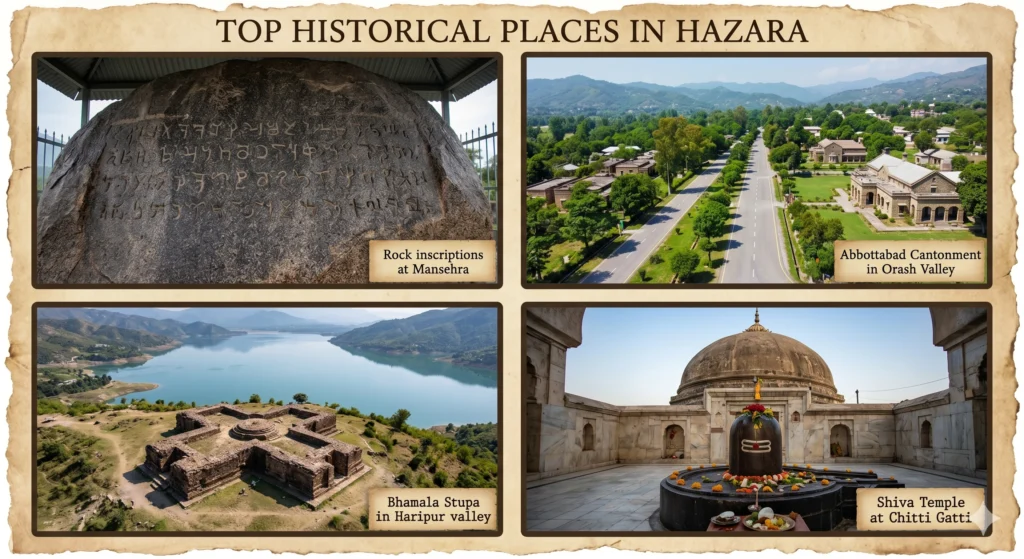
Carved in the 3rd century BCE under the direct supervision of the Mauryan Emperor Ashoka, these fourteen edicts are etched in Kharosthi, an ancient script that reads from right to left. What makes these stones remarkable is what they say. Rather than boasting of bloody conquests or imperial expansion, Ashoka used these rocks to publish a public manifesto of Dharma (righteous living). The inscriptions call for absolute religious tolerance, kindness to animals, justice for all social classes, and the establishment of medical care along trade routes. Standing before them, you realize that this busy valley was a crucial administrative core of an empire over two thousand years ago.
2. The Bhamala and Jaulian Buddhist Complexes (Haripur)
While the ancient city of Taxila is world-famous, many people do not realize that a significant portion of its most spectacular archaeological heritage actually falls within the administrative borders of Haripur District in Hazara.
- The Bhamala Stupa: Situated next to the scenic Haro River near the Khanpur Dam, Bhamala is an absolute anomaly in Gandharan architecture. Unlike the traditional round stupas found across Pakistan, Bhamala features a rare, cruciform (cross-shaped) layout that resembles Aztec pyramids more than standard Buddhist structures. Excavations here unearthed a massive, 14-meter-long stone statue of the Buddha entering Nirvana, making it one of the largest death-bed depictions ever found in the region.
- Jaulian Monastery: Perched up on a hill nearby, the Jaulian site offers a deeply intimate look at the daily lives of ancient spiritual ascetics. Walk through the preservation chambers to see highly detailed stucco sculptures of the Buddha surrounded by lions and elephants. The site also includes an ancient healing stupa, where travelers once left offerings in hopes of curing bodily ailments.
3. The Zar Dheri and Bado Dheri Sites (Mansehra)
If you venture further into the rural heart of Mansehra along the Silk Road paths, you stumble upon the sprawling ruins of Zar Dheri (which translates locally to “Golden Mound”). First officially documented in the 1920s and extensively excavated by a joint Japanese-Pakistani archaeological mission in the late 1990s, this site revealed a highly sophisticated ancient monastic network.
Archaeologists discovered an incredibly preserved cruciform stupa and a dense collection of over 140 beautifully carved schist stone panels. These reliefs depict intricate narratives of the Buddha’s life, showing strong stylistic links to both classical Gandharan and early Kashmiri art styles. A short distance away lies Bado Dheri, another recently excavated monastic site that continues to yield ancient pottery sherds, iron implements, and old coins that help historians chart the precise timeline of when Buddhism flourished and faded in these hills.
4. The Old Fort of Mansehra
For a completely different era of history, head up to the Upper Nogazai area within Mansehra city. Standing on a high-altitude ridge overlooking the urban layout is the Old Fort Mansehra.
Built initially during the early 19th century by the ruling Sikh Empire to secure their highly volatile northern frontier, this fort served as a vital military stronghold. When the British Raj annexed the region in the mid-1840s, colonial forces occupied the structure, modifying its architecture with classic colonial-era brickwork and massive stone bastions on all four corners. Recent excavations by Hazara University have uncovered old British coins (including pieces from the reign of King George VI), rusted weaponry, personal ornaments, and military uniform buttons, painting a vivid picture of frontier garrison life during the transition of empires.
5. The Colonial Architecture of Abbottabad Cantonment
To experience the distinct vibe of mid-19th-century British frontier life, a walk through the Abbottabad Cantonment is essential. Founded in 1853 by Major James Abbott, a British military officer and administrator, the town was designed to serve as a high-altitude military base and a sanatorium for British soldiers escaping the brutal summer heat of the Punjab plains.
The cantonment area has successfully retained its classic colonial layout. Walk down its wide, quiet, tree-lined avenues to observe the stone bungalows, old red-brick administrative blocks, and historic churches like St. Luke’s. The center of social history here is Lady Garden Park. Inside, you will find a beautifully preserved marble monument engraved with the famous, bittersweet farewell poem written by James Abbott himself, dedicated entirely to the Orash Valley and the local people he grew to love before returning to England.
6. The Sikh Roots & Kenthla Baoli of Haripur
Before Abbottabad was built, the main administrative capital of the region was Haripur city. Founded in 1822, it was named directly after its creator, the legendary Sikh General Hari Singh Nalwa. Nalwa was tasked by Maharaja Ranjit Singh to pacify the fiercely independent tribes of Hazara, and he built a sprawling mud fort known as Harkishan Garh to anchor his rule.
While much of the old fort’s walls have been absorbed by modern buildings, the grid-like planning of the old bazaars still tells the story of its early 19th-century commercial origins. If you track the older trails leading toward the scenic Margalla hills on the border of Haripur, you can find the Kenthla Baoli. This is an ancient, hand-carved stone stepwell built along old trade routes, designed to provide a cool, reliable water source for traveling caravans, soldiers, and merchants navigating the rugged mountain passes.
7. The Ancient Shiva Temple (Mansehra)
Located just a few kilometers north of Mansehra city along the Main Karakoram Highway is the Chitti Gatti Shiva Temple. This site is a profound symbol of the multi-layered spiritual fabric of Hazara.
The temple houses a massive, ancient Shiva Lingam that historians estimate to be thousands of years old, attracting pilgrims for centuries. Interestingly, the architecture of the temple structure itself reveals fascinating adaptations of late-Mughal and early Islamic architectural styles, showing how different cultural eras seamlessly blended together in this geographical meeting point.
Traveling Through Hazara’s Timeline
To help you conceptualize your journey through the different centuries, here is a quick breakdown of how these historical landmarks fit into Hazara’s broader timeline:
| Historical Landmark | Location (District) | Architectural / Historical Era | Approximate Age |
| Ashoka Rock Edicts | Mansehra | Mauryan Empire | ~2,300 Years Old |
| Bhamala & Jaulian Ruins | Haripur | Gandhara / Buddhist Era | ~1,600 to 1,800 Years Old |
| Zar Dheri Complex | Mansehra | Kushan / Gandhara Era | ~1,500 Years Old |
| Chitti Gatti Shiva Temple | Mansehra | Ancient Roots / Later Reconstruction | Centuries Old |
| Haripur Old Town Layout | Haripur | Sikh Empire | Built in 1822 |
| Old Fort Mansehra | Mansehra | Sikh Era / British Raj Alterations | Early 1800s |
| Abbottabad Cantonment | Abbottabad | British Colonial Era | Established in 1853 |
A Note on Hidden Districts: If you are an absolute hardcore explorer, the northernmost districts of Hazara—like Battagram, Torghar, and Lower Kohistan—are currently being surveyed by local universities. They are revealing dozens of newly cataloged, untouched ancient cemeteries from the Iron Age (Gandhara Grave Culture) and old Buddhist cave complexes hidden in the sheer cliffs overlooking the Indus River.
When you travel through Hazara, remember that you are walking on old dirt that has been trodden by Alexander the Great’s supply lines, Chinese pilgrim monks like Xuanzang (Hiuen Tsang), and generation after generation of diverse tribal cultures. Slow down, skip the highway bypasses, and take the time to explore these landmarks.
Leg 1: The Khanpur Valley Heritage (Haripur District)
Your journey begins right at the southern border of the Hazara region, easily accessible from Islamabad or Taxila.
Bhamala Stupa
📍 Buddhist temple
- Stop 1: Bhamala Stupa Click to open side panel for more information
- Where it is: Tucked away near the banks of the Haro River and Khanpur Dam.
- Why stop: This is your introduction to Hazara’s early history. Spend an hour exploring the unique cross-shaped ruins and visualizing the ancient lakeside monastery before heading out.
Jaulian Buddhist Stupa & Monastery
📍 Tourist attraction
Closed· Opens 9:00 AM Sat
- Stop 2: Jaulian Buddhist Stupa & Monastery Click to open side panel for more information
- Drive time: ~25 minutes from Bhamala.
- Where it is: Perched on a nearby hill overlooking the valley floor.
- Why stop: Walk up the hill to view the remarkably preserved stucco carvings and healing stupas. This site gives you a vivid sense of the secluded lifestyle ancient monks cultivated here.
Leg 2: The Sikh Heartland (Haripur City)
From the peaceful Khanpur Valley, drive north along the local highway routes toward the urban heart of Haripur.
Harkishan Garh Fort
🏛️ Historical place
Open
- Stop 3: Harkishan Garh Fort Click to open side panel for more information
- Drive time: ~40 minutes from Jaulian.
- Where it is: Situated inside the old, grid-planned center of Haripur city.
- Why stop: This marks your transition into the 19th century. While modern structures have largely integrated with the historic footprint, walking the old bazaar area grounds you in the town’s military layout built by Hari Singh Nalwa. (Note: The ancient Kenthla Baoli stepwell is located along the mountain trails east of this corridor if you choose to take a rural detour).
Leg 3: The Colonial Ridge (Abbottabad)
Leave Haripur behind and take the Karakoram Highway (N-35) or the Hazara Motorway (M-15) climbing into the cooler mountains of the Orash Valley.
Cantonment Board Abbottabad
📍 Government office
Open· Closes 5:00 PM
- Stop 4: Cantonment Board Abbottabad Click to open side panel for more information
- Drive time: ~50 minutes from Haripur.
- Where it is: The older, heavily wooded northern sector of Abbottabad.
- Why stop: The ideal spot to spend an afternoon or stay overnight. Explore the wide, tree-lined streets, colonial bungalows, and historic stone churches. Make sure to stroll through Lady Garden Park to see the monument featuring James Abbott’s famous farewell poem.
Leg 4: The Ancient Crossroads (Mansehra District)
From Abbottabad, continue driving north for about an hour into Mansehra District, where the ancient and late-imperial eras converge.
Old Sikh Fort Mansehra
- Stop 5: Old Sikh Fort Mansehra Click to open side panel for more information
- Drive time: ~45 minutes from Abbottabad.
- Where it is: Located in the high-altitude Upper Nogazai and Old Tehsil area of Mansehra city.
- Why stop: Walk up to the ridge to view the historical stone bastions where the Sikh Empire and later the British Raj stationed garrisons to monitor the wild northern passes.
- Stop 6: Ashoka Rocks Edicts 1
- Drive time: ~5 minutes from the Old Fort.
- Where it is: Situated at the base of Bareri Hill, just off the city lanes.
- Why stop: The absolute climax of the route. Take your time examining the ancient Kharosthi inscriptions carved directly onto the granite blocks, dating back to 250 BCE.
Shiv Temple ,Chitti Hatti
🛕 Hindu temple
- Stop 7: Shiv Temple ,Chitti Hatti Click to open side panel for more information
- Drive time: ~15 minutes north from the Ashoka Edicts.
- Where it is: Right along the Mansehra-Shinkiari Road in Chitti Gatti.
- Why stop: The final destination on your route. Witness the ancient Shiva Lingam and observe how late-Mughal architectural aesthetics blended with older spiritual sites along this ancient road.